MASTERPIECE
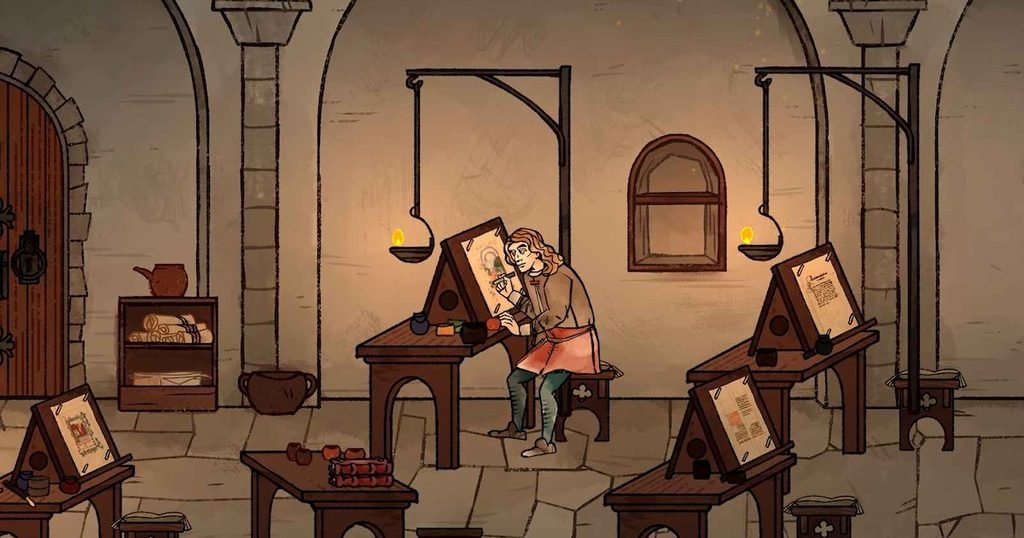
A renaissance for historians. Obsidian’s newest title delivers the latest argument for video games as an art form. A timeless tale of love, religion, and most importantly faith in our fellow man. Taking place in the 1600s, the game, peculiarly, starts far away from any sort of prominence during that age, focusing instead on the indistinctive village of Tassing. Andreas Maler, an illustrator, is caught up in a series of murders and is tasked with finding the killer lest his mentor (and later the whole Abbey) are wrongfully condemned. Pentiment doesn’t shy away from the severity of life during this period, and goes full throttle showing the harshness of the Abbot, the injustice done to its villagers, and the efforts of a stranger charged with the burden of peacekeeping. We see the lives of the peasants through Andreas over two periods of his life, and later through his friend’s daughter Magdalene (and my favorite character I might add).
We don’t start the game arriving in Tassing, instead we start with Andreas already having arrived in Tassing, and started working in the scriptorium at the Abbey. The key difference here is that Josh Sawyer, the game’s director, trusts the players to figure out the characters and their relationships from the conversations they have with each other instead of having this information spoon-fed to us from the get-go. There is no new recruit, or a new character entering the village like many stories and video games are wont to start off; his trust lets the game skip a fair amount introductions and handholding, and throws us directly into the fray (and even if the player ever gets lost, all NPC information can be found in the archive Andreas has). We spend most of our time in that scriptorium listening to the mesmerizing sound of pen being put to paper, talking to our mentor Brother Piero about our job and its future bleakness, and learning about the inner workings of the church and its relationship with the peasants. There is an abundance of life portrayed in that Abbey, and stepping outside it into the lushly painted world of Tassing overwhelmed me with pressure and excitement. There are so many people to talk to, and, with the game allowing the player to customize Andreas’s skills and knowledge, even more ways conversations could go. The replayability options are countless; I wanted to hear everything these people had to say, and see how Andreas’s knowledge changes the flow of conversation and the choices available. There is never a dull moment to be had as the writing is impeccable, and the extra care given to making sure the dialogue flows nicely hasn’t gone unnoticed. It’s the small design choices that dress up the game in its historic veil, and immerse us in its world. Different fonts are used to show the class of the character speaking. If a character stutters, a letter is erased and rewritten inside the dialogue box, and if someone is yelling ink dots are splattered all over his speech. These are just some of the fun and inventive ways Pentiment goes about customizing its people. Sometimes a word is omitted and written at the end to draw attention to it, and if a character (like Magdalene in Act III) bobs their head, their dialogue box bobs with them. The creativity is endless, and it was so fun watching out for all these quirky designs.
We get used to life in Tassing until a patron of the Abbey, Lorenz Rothvogel, who also happens to be the Baron of Rothvogel, decides to visit, kick starting the tragedies to come, and our involvement in them. Lorenz seems like an amicable gentleman, but has already gotten on the bad side of most characters within days of coming here. He criticizes Piero for being too slow with his commission, requests Andreas does it instead (it would’ve been nice to have an option to tell him to sho** it), and he had assaulted a nun from the sister monastery in the past. The guy does his best to get on everyone’s bad side, but stops short of having a sign on his back that said “kill me”. His eventual death comes as a no-shocker, but it was the Abbot imprisoning Piero that involves Andreas in the murder. Before his death, Lorenz questions the history of Tassing leading the Abbot to end the discussion, and any further debate we could’ve engaged in. Pentiment excludes nobody. Every person in Tassing has something to say about the events, and we start getting access to areas previously inaccessible in our daily routine. Plenty of surprising puzzles come up, and solving them only deepens our interest in the conspiracy forming in front of us. Here is how Pentiment plays it smart. There are too many clues! So many notes scattered around the Abbey and Tassing incentivizing people to kill the Baron. When questioning people, your choices are more paramount than ever with the game alarming you with a “This will be remembered later” warning popping up every now and then. If you weren’t paying attention, you are now. Eventually, you will reach enough evidence to trying convincing the people withholding information from you to reveal it. All the choices you picked come back, and if you made a sound enough argument (or reached a certain affinity with someone), you’re rewarded. It’s good to know that the game never forgets a conversation, but also pressuring since one mistake can lock you out of further inquiry for the rest of your investigation. By the end of it, I had explored all of Tassing and at no point did I feel like I wasted my time exploring a location. Tassing is designed sparingly having the bare essentials for a village. Two farms, a couple of inns and houses, a stonemason, a mill, a church, etc… Each area feels like it was pulled straight out of a painting, specifically the paintings from the scriptorium Andreas works in. No area overstays its welcome, and you can effortlessly move between them after a couple of steps. The washed out colors at the edges of the households, the shading on peoples’ clothes making them seem older or uncertain, and the constant animal sounds go a long way in bringing Tassing to life. Moving from one place to another is accompanied by a page flipping animation and sound, and after all the investigations, the adventures, and the faithfulness to the time period, the game’s biggest accomplishment shines through. Pentiment made me feel like I was dancing through the pages of history.
After your limited time is done, the trial is here. Three different suspects are given in the first and second acts of the game, but for this one I went with an Abbot brother whom I had the most evidence against. Brother Piero was saved not that anyone was thankful. Two characters that should be introduced here are Otto (a town leader who aided you in the investigation, and has a grudge against the Abbot), and father Thomas (Father of the in-town church). It was time for Andreas to leave and head back to his homeland, but not before he is thanked by Piero, and after making his rounds saying goodbye to everyone he takes his leave and Act I ends. Years later Andreas is rocking a full beard, and has an apprentice. He comes back to Tassing passing by, and learns that things are far worse than when he left. Piero had died of old age, so sadly we couldn’t see him again. The old cast of characters are back, but with their children now grown and having their own storylines. The player is forced to meet with the reality of the situation. We are a stranger Tassing, yet we put our nose in this town’s affairs and caused the death of a Brother. Now we learn that that person was supplying the Abbey with funds necessary for its survival. Having lost that income, the Abbot turned to raising the taxes and imposing a hunting fee for the forest; obviously these new rules cause further disagreements with the peasants igniting them to fight back with a revolt. Our meddling has caused this town, that we only resided in for a few weeks, much suffering and changed it for the worse, so when this time the Abbot asks for our help it gives us pause. We don’t want things to get worse, and we don’t want to overstep our boundaries this time. We are meant to reexamine our stance here. Sure the Abbot is a heartless monster, but that doesn’t mean we want the revolt to succeed and burn down the Abbey. There are innocent books people there! The Abbot wants us to talk sense into the people to stop the uprising, but things go awry when, on the night of the meeting, Otto, the man in charge of the revolt, is murdered. Sadly, the Abbot has an alibi, Andreas. The game specifically puts Andreas and the Abbot together during the time of death since it knows he would’ve been our main suspect otherwise. The cycle starts again, but this time everyone wants Andreas to give them the killer, and of course we are being extra careful going around pointing fingers. One thing is made apparent right away though, the same colored note and handwriting is found next to Otto. We immediately think that we killed the wrong person in Act 1, but when this Act’s three main suspects are different people altogether, a different theory comes to mind. The game won’t give out a true killer. It doesn’t need to, because its more interested in showing the consequences that follow these killings. What matters is that the Baron died and the peasants suffered. What matters is that Otto died and the peasants are still suffering. The Abbot didn’t know where to draw the line and in the end it all came crashing down, literally. Driving home the point that the finding the killer is secondary, and that the peasants just want their suffering to stop, it doesn’t matter who you choose to kill, the revolt still happens, and the Abbey was set on fire. No good deed ever goes unpunished, even if Andreas thought he was doing some good by identifying the real killers in Act I and II, these people are starving and the Abbot refuses to change his ways. “Nothing ever changes” the last words said before the Abbey is burned. Andreas rushes in to save as many books as he can before all the town’s history is lost. Some kind of change was needed, and the peasants took it upon themselves to make sure something came out of this. Andreas saved some books, but at the cost of his life. Act II is in direct contrast to Act I. The former ended with hope that we changed the situation of Tassing for the better only to find the opposite happened, while here the ending screams nothing but despair only to have, as Act III shows, the opposite has happened.
I thought the game would end after Act II, Andreas was dead and a narration started floating overhead, but instead Act III started and suddenly I was Magdalene. Starring the daughter of the local painter, Magdalene takes center stage here and we see the fruits of revolution and the ashes of growth. Many people died after the revolt, which now has happened more than a decade ago, and the new generation is taking over. Before, we rarely saw a teenager outside of work, but now there is a group of them playing around. Pulling pranks, participating in social groups, and many other activities are available to them. People have time for leisure, life isn’t as stressful as it once was. Many of the peasants still argue that the revolt was doomed from the beginning, but no one can deny that life had gotten simpler since then. The Abbey had burned down, taking with it the harsh life the people had endured. We can’t know what the right decision was back then, no more than we knew the first time around. What we can hope for is that the future generation lives a better life than we did, and that we can pave the way for them.
Magdalene, like Andreas, is customizable allowing for new options and this time from the female perspective. Magdalene’s father wants to paint a mural depicting Tassing’s history up until the revolt. He butted heads with the town council many times as they refuse to have the Abbey depicted is such a negative light even if they were at fault. Not backing down, he is attacked in the middle of the night putting his life at risk. Magdalene, knowing how much this mural meant to her father, decides to paint it herself. The roles of women in Tassing are very limited, and all are expected to marry and have children before they can voice an opinion. Magdalene choosing to paint the mural is already met with doubt because of her gender, especially from father Thomas, who keeps trying at every opportunity to insist on a better representation of the Abbey. Magdalene doesn’t budge, and taking it upon herself to make sure the mural is completed. This is when we go around asking the new denizens of Tassing about its history. Some tales seem embellished, but more importantly is how the people came to view Andreas. Having played as him we know every thought that went through his head, so we can confidently say that he had the best of intentions during his investigations. Andreas isn’t remembered that fondly by some and is seen as the reason things got out of control. You can’t please everyone, but at least some people remember the tried and true hero he ended up being. All the while, almost every woman you come across talks to Magdalene about her eventual marriage with Otto son of Otto who died in Act II. It was never about Otto specifically, but having everyone deciding your future for you made me glad I told them all off whenever I was given an opportunity. We know that the story isn’t over, someone was still attacked, and the same handwritten note later makes its way to Magdalene’s bedroom. Magdalene stops at nothing in her pursuit of the truth, and eventually we learn that Andreas had survived the fire and has been hiding underground all this time trying to find the thread-puller while keeping Magdalene safe. Having our two main characters join up was such an exciting moment, and so they went to face the killer. It turned out to be father Thomas whose motive was the truth he learned about Tassing’s history. The Christian tales the people were told were all lies, and most of the statues surrounding the town and were of Pagan origins. He didn’t want peoples’ faith to be lost, and thought it would be if they ever found out that the artifacts they were worshipping weren’t what they were led to believe. These are all lies he keeps excusing himself with. This story is about one man’s faith or lack thereof, father Thomas. He couldn’t handle the truth causing his own faith to become weak. He killed the previous Abbot before the start of the game, and has gone on to incentive people to murder on God’s behalf. The man has no faith in the peasants, and whatever faith he claims to have in God seems long gone. It was his beliefs he was trying to protect. Beliefs so brittle he tried erasing and rewriting history to protect them. You are given a choice to tell the people the truth of the tale after the confrontation or to keep it a secret. I chose to tell them. People’s beliefs and faith aren’t so weak that they would break once they learned the truth. History has proven that people will defend their faith even if they’re in the wrong. A little bit of trust goes a long way, and these people have proved to be more than capable of handling themselves and what they believe, Magdalene is proof of that. She is the proof that Father Thomas failed to see. He was afraid that if the artifact the people were praying to at the monastery was revealed to be of pagan origins people would think that God wasn’t listening their wishes. For a church father he failed to remember a basic principle of faith. God doesn’t need a medium to listen to you.
The mural is finally finished, and so has our time with the game. Magdalene chooses to leave Tassing to see what else lies beyond her world. Andreas chooses to stay in Tassing, and help the Peasants. Before she leaves, Magdalene hugs Andreas thanking him for all the good she has done her town and her family. Magdalene had so many expectations on her and she met all of them. She took care of her dying father, learned about the town’s history, and painted a mural that cemented itself as Tassing’s historical landmark. What gets painted is what the player chooses and I chose the truth, black and white. The hug Magdalene gave Andreas meant the world to me. All our efforts in the previous Acts felt worth this moment. We finally have someone thanking us for all that we have done, and it came from the person we’ve known and loved. Years later Andreas also contributes to the town’s history by painting a mural next to Magdalene’s this time showing the town’s ancestry up to 1557. There are so many more adventures to be had in Pentiment that I didn’t discuss as I wouldn’t want to spoil all the surprises for future players. Magdalene was in Tassing, in 1557 so was Andreas, and thanks to Josh Sawyer so was I.