NOT RECOMMENDED
At what can now be seen as his prime, Hato managed to deliver a fresh take on the classic rom-com genre in Nora to Oujo. He created a wonderful cast of characters centered around an interesting main character as we followed their lives in a town where the supernatural was a daily occurrence. I was completely taken in by the vibrant lively town of Sakuragabuchi, its quirky residents, and the surreal aspect of the writing that mixed the randomness of something like Courage the Cowardly Dog and the deadpan absurdism of Welcome to Nightvale. It was as dramatic as it was absurd, but Harukaze and Hato would ultimately ditch this style of writing as we see a shift to the realm of pure comedic insanity with their next games. Monkeys like Nora to Oujo 2 and Marco and the Galaxy Dragon, sadly plays into this style. It is only interested in overloading the audience with jokes and cheap thrills abandoning anything that doesn’t end in a punchline. What starts off as a simple boy meets girl premise, quickly destroys the wonderful chemistry that is instantly crafted between the two leads Saru and Karasu as their relationship is shackled to the true route of an unnecessary and aggravating route system. The story lost its appeal when Karasu is sidelined to give the less interesting sub heroines the spotlight, and it never fully regains the charm it had in those first two hours. Monkeys’ route system killed it. Had this entire visual novel focused only on Saru and Karasu (as it should’ve been), I would have been enthralled with it. Hato though, seems to have lost all interest in writing compelling relationships, and is afraid of touching on anything real. He settles for churning out comedic duos, and is now writing beneath his aptitude with every sentence a joke or a play on words and with Shiravune’s less than enthusiastic translation a badly translated one.
With the impending closure of his all-boys school, Saru decides to co-ed with the all-girls school, so he visits one of the big three student council presidents at her hospital bed where he finds her dying (of boredom). What follows in the marvelous way the characters play off each other hooks us immediately. He won’t allow her to (fake) die in peace, and she constantly tells him to shut up and quip over his every word in her mind; she doesn’t want to move her lips or give off any indication that she’s alive. Their conversation is filled to the brim with energy, and we sense that even the voice actors are trying to hold back laughter during this entire sequence. It is rare to find two characters overlapping each other with dialogue so funny one barely has the capacity to react to all of it. Saru “brings her back” by comparing her to beautiful things, like the moon, but gradually gets less apropos until eventually he compares her to a dinosaur. This is what causes her to spring back up and yell at him. She feels he can liven up her daily life, so she agrees to help him knowing that her school is having similar issues. She dresses him up to infiltrate her school and she dresses up as a boy to infiltrate his with the ultimate goal of learning how the opposite sex behaves and see how they can go about merging both schools.
Saru is played by the talented Tanezaki Atsumi who also played Yuuki in the company’s earlier Nora to Oujo series. She plays Saru with the confidence of a gang leader capable of standing at the top of the school’s pecking order, while also having the innocence to take a girl to bed and the next day ask his friends: “What’s a virgin?”. Karasu is also played by a Nora to Oujo veteran, Taichi You who voiced Lucia, but like her route in the previous game, she has to subdue her performance to only deliver what she’s allowed to due to the limitations of the script. Karasu comes from a rich family that pay off every friend she makes for their “service”, and she seems to have a father who won’t generally give her the time of day. This is the extent of what we’ll ever learn about her family or their involvement in the plot. Garasu, a beautiful blonde girl and the head of the Student Council, is raised by her aunt and uncle, and is having to endure suffocating pressure from the latter as he keeps arranging marriages with rich men for her which he forces her to accept so they can live lavishly as payment for taking care of her all those years, but the way her uncle is written is so laughably evil and makes this issue impossible to take seriously. The men he arranges for her are so blatantly corrupt that they barely draw short of having the word “Rapist” visible on their forehead. The last two sub heroines Yuki and Mebachi have similar problems with their parents that are dealt with in similarly facile ways. The biggest victim of this is actually Saru and the relationship he has with his parents. Hato’s main characters seem to be defined by how deep their mother issues go. Saru’s mother disappeared when he was young after playing around with different men. Sometime later a strange man appears and invites him to live with him and tell him his mother won’t be coming back (I think there was a gunshot before this man appeared?). We don’t know if this man is Saru’s actual father, and like the company’s previous endeavors one should expect only half-hearted dodgy attempts at explaining this situation, which at this point may also be called a hallmark of his writing. To this day I still don’t what was going on with Iris’s mother in Nora to Oujo 2 or what she tried to achieve. Nor do I know what to make of Marco seeing her mother killed or shot in the opening scene of Marco and the Galaxy Dragon only to find out that maybe she wasn’t? Or that she might have a family who similarly don’t know what to make of their situation. After marrying again and divorcing again, we get the sense that Saru’s father made some kind of mistake which is why his new wife left him, but seeing him throughout the story we aren’t sure what that could be. It doesn’t look like he cheated as no other woman is ever brought up. I think what we are generally supposed to take from this is that he couldn’t rise to some occasion when his wife needed him? If Hato wanted us to feel something for this new broken family, then invite us into the drama. Not knowing why this blue collar worker who works hard all week to make sure that his ex-wife, who only ever criticizes him every chance she gets, gets her alimony only presents the situation as one-sided and making her out to be the villain. When he is apologizing and telling Saru to do better than him, we still don’t know what that means. Hato’s refusal to tackle any of these problems that have some room for dramatic development seriously is what most of the issues in this game are centered around, and so the voice actors have to make up with their limited screen time for the inadequacies of the script.
The usual entourage of overenthusiastic students, overbearing parents, and wild animals who form the brunt of Hato’s cast in his other games, make a return in this one, and as with all of his characters, no one is without their eccentricity. We have Garasu who can learn everything there is to know about a person even the last numbers of their credit card just by hugging them. There is Saru’s friend Okita who turns into a silent killer ready to kill anything that moves when he gets a long hard rod in his hands, and Yamapi an important member of the all-boys school and happens to be a bear. The same ingredients are gathered, but they weren’t able to do something worthwhile with them this time around. The game averages about twenty hours, but I had finished it in less than fifteen. I leave it to you to imagine how a game was able to fit four routes into that limited runtime. Mebachi’s route doesn’t even have much to do with the overall school co-ed plot, and only seems to focus on her. The game’s structure felt like a contractual obligation most of the time. Saru and Mebachi have almost no romance on screen. A problem happens at school that causes her to move in with him. I stopped, thought back for a minute, and remembered that she doesn’t know he’s crossdressing, so she somehow agrees to move in with a man she barely knows instead of literally anywhere else. After she tries to kill him, she sniffs around his room for a bit, she remembers that they met when they were kids, and decides to sleep with him. It should be noted at this point that logic isn’t this games strong suit. The way I framed those scenes is the way they are frantically thrown around in-game. Everything is happening so fast we barely know what is going on, or what we are supposed to be reacting to. She and Saru have a conversation about food before she abruptly asks, while blushing, what she has to do to get eaten. Now, if there was any point in this entire game that frustrated me to no end it was the fact that this line was used in a route with no chemistry between the characters and no proper romantic build up. This is a line men dream of hearing! I don’t even know how they ended up in a relationship by the end of the route and at this point I’m not even they do. Garasu plays the role of the scream queen that Harukaze has made sure to include in all their games. She starts out prim and proper before she becomes clingy and loud anytime Saru is near her. Here we see the staff playing around with the same ingredients from Michi’s route in Nora to Oujo and Iris from the sequel, and the result is as derivative as one might expect.
There is no masking that this is a Hato work. Monkeys is steeped in conventions. Not normal conventions, but the ones that he (and maybe Harukaze as a whole) pigeonholed himself into. We play knowing exactly what are getting from him, and he doesn’t seem interested in evolving his writing past his old works which now seem out of his depth. There is no excitement in anything new, and the lack of care towards anything that could make us clutch at our emotions is the only thing he keeps getting better at. Hato is afraid to linger. He appears to be appealing to this new generation raised on instant gratification and short attention spans. He fills the screen with as many audio, visual, and written gags as he can. Scenes are jumped through so sporadically; one can easily smell the desperation. I remarked a scene where the characters were laughing, then the game shifts ten scenes later and one of the characters was in the hospital bed in pretty bad shape, then shifts right back to the original scene. I wondered if the game glitched by showing me this scene, but no it was actually being serious.
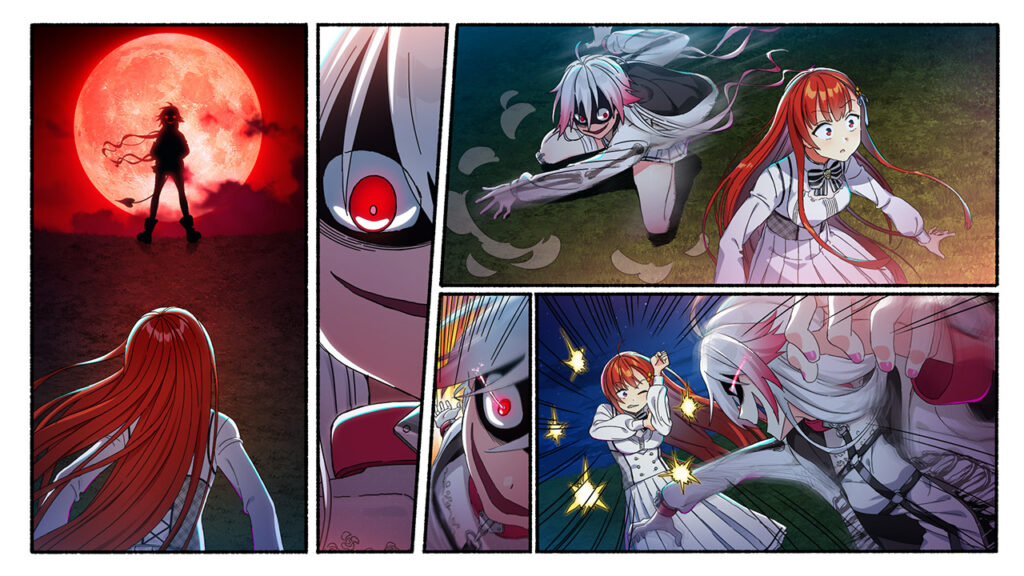
One of the things I love in Harukaze is that they aren’t afraid of experimentation. Marco and the Galaxy Dragon is a short visual novel filled with colorful creatures and aliens all of which are portrayed within the game’s one thousand cgs. It is amazing what this company was able to achieve in such a short VN what Chiyomaru Shikura tried to do with the Sciadv series for years and failed. The game also featured amazing highly stylized animation cutscenes that gave the game a western feel to it. Thankfully, they decided to try some new things in Monkeys as well. The story is told like a comic strip with colorful panels placed on the screen every now and then to add some variety since the game features too few backgrounds. I also love it when you can learn more about a character by seeing how their sprites appears on screen. Garasu, for example, demands the screen. Whenever she appears, she takes up two thirds of it, and during the entire game she never shares it with anyone else. She is prideful and lonely, that is what her sprites suggest and what she actually is in-game. On the other hand, maybe the rich and numerous panels made for the comic strips seem to be the trade-off for how many characters get sprites and the number of sprites each character has. Each character in Nora to Oujo has at least three different set of clothes that they shuffle around. The characters in Monkeys rarely wear anything besides their default. This is something I expect of other visual novels, but I not the ones from Harukaze. None of the character’s parents besides Saruyoshi’s get sprites (Yumi’s mother has a single one though), and there are too few expressions for the character who have sprites at all. The character designs, drawn by Cake, are cute enough and Karasu’s especially are expressive enough, but for their debut as the lead in a Harukaze work I was expecting much more. I think it was obvious where the budget was being focused, especially when they didn’t even hire a professional bear to voice Yamapi.
I had hoped for much more with this game. There is a gradual disregard for serious plot developments with every new Harukaze release. I had hoped that Hato would portray his characters with more confidence, but now they just keep prattling on and on until the author doesn’t know what they wanted to say anymore. The original problem I had with Hato’s writing is worsened here. Before it was mostly the resolutions that were abrupt, but the buildup, romantic chemistry, and grounded problems were all there. Now all of that is gone (as if they were the problem), and what we are stuck with is desperate ambivalent storytelling.