RECOMMENDED
Warning: Game has 18+ scenes
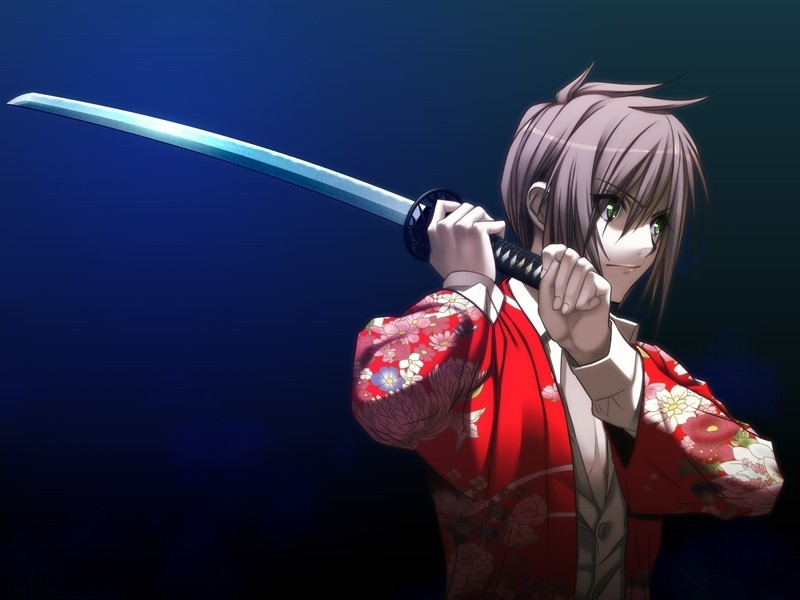
Hanachirasu presents an interesting challenge with regards to how stories are told. Regardless of the medium, how much less time would be wasted if authors decided to steamroll to their point without obstructions. No side-stories, no divergences, and a new respect for players’ time. This game goes full speed ahead right from the start, and embodies its characters with a sense of forlorn realism rarely expected or achieved in contemporary short stories or similar anime-like storylines.
Taking place in an alternate history where nuclear weapons were never invented, Japan was never bombed, and now a new Tokyo is surrounded by walls allowing no guns to pass through. The leader there wants to revitalize the old Japanese spirit, so people speak through their swords rather than their guns. The two opposing sides trying to take over Tokyo are the Takigawa corporation, and the Hokodome-no-kai movement. It is easy to think of this leader as an author self-insert and this game as a passion project given the amount of sword technique exposition, and lore written for a game that is not even an afternoon nap long.
Nitroplus, being no stranger to introducing its main characters at their most vulnerable, starts off the game by showing us a helpless young man taken advantage of by a dominatrix working for the Takigawa corporation. Terrorists attack the building intending to take her out, and easily slice through their defenses to get to her. The boy’s face who has up until now been hidden, and neglected by the much bigger emphasis the cg had on his sadist, gets up, grabs his sword, and dons his fate. The boy’s face and name are finally revealed as Akane our main character. The entire scene shifts along with the camera, and we immediately feel that something is wrong. He is shown in full view in a Dutch angle while all the colors on screen are intensified to match his lust. This is a technique used very frequently throughout the game, and the cgs are beautifully framed and colored to show each character’s frame of mind. He makes quick work of the terrorists, and we are then introduced to his past rival. Yoshia makes his entrance by beheading the aforementioned dominatrix before finally finding Akane, and challenging him to a duel long-in-waiting. His reason is simple, Akane killed his fiancé in cold blood. The game’s narrative is set and decided within the first act, but unlike many stories it doesn’t take long for the game to make good on its promise within only hours of starting it.
This idea of rivals seeking each other out must be the most overdone cliché in Shounen manga especially because outside of Goku and Vegeta or Joe and Rikishi it has never been done as effectively as the authors thought it should. Others just keep picking up the mantle and only ever seem to succeed in wasting ink. From Naruto to Bleach to My Hero Academia to Black Clover etc… there are so many stories that would’ve saved the audience plenty of time and investment if we were just given the carrot early. Hanachirasu doesn’t pretend to have a grand plan of a narrative slowly being built around its lead characters. Narahara Ittetsu shows the consequences of two characters being hard-set on killing each other in a much more realistic fashion than other titles that make use of similar themes. Tokyo’s politics and history have been built for years by people who shed tears and blood getting to where the story starts, and it now rests in the hands of two people who couldn’t care less about it. The story starts at its end. These two met, became friends, trained together and had their big fight. What we are playing here is the epilogue. This game came out in 2005, and if only Kishimoto had checked this title out sooner then maybe Naruto and Sasuke wouldn’t have had to spend the next 9 years flirting. Someone should show Yūki Tabata this game, so he can put his pen down too.
After losing each other following that original confrontation, they waste no time trying to find each other. Akane, having courted the leader of one of the main branches of the Takigawa corporation, uses her influence to launch a full scale attack on their enemies headquarters. He leads the attack and slices everything and everyone to get to Yoshia, but he is nowhere to be found. The story makes no assumptions about Akane nor does it ask the audience for their sympathies. We are meant to be vexed and fearful of the relief and safety we feel with him as every decision he makes paints him as the villain of the story, even though we are never in doubt over his skills. There is a beautiful moment during the attack where Akane, who has been heeded by his 2nd hand man about the rashness of this endeavor, stops and listens to him. This man was being ignored by us and him, but when Akane stops, it is as much as a shock to him as it was to the audience. He has been peeling back Akane’s character only to arrive at what Akane deemed worthy of listening to. He asks the man’s name while removing his characteristic smile as they venture further into enemy territory. Moments later after seeing this soldier fall into a trap behind a door, admits that even he wouldn’t have been able to stop it either. His personality isn’t one born out of convention. His arrogance is one fostered over years of experience and not by the novelty of a child finding a toy and rushing out to test it. He never misses practice and takes it as seriously as any life-threatening battle. It is always reassuring to know that the director can guide us to feeling about a story what he himself felt, and what I felt was that the author knew enough about his characters to make sure I did. Yoshia soon launches a different attack on a main Takigawa Branch only to similarly discover that Akane isn’t there. He was visiting his sister in the hospital.
While playing this game, we are saddened by the constant bombardment of lost days spent waiting for other stories to deliver on promises this game dealt with in record time. Gone is the training arc, the rehashed monologues, the philosophical extremities, the second training arc, and the long endless corridor of procrastination. Both these characters want to find each other as soon as possible, but they genuinely don’t know where the other one is, so blood is the only crumb they can leave behind. A lot of people get killed in the crossfire, and they all go out the same way as confusion and shock are the only appropriate responses when you are robbed of your life for the crime of involving yourself with them. Characters are introduced and killed within minutes, bonds are forged, pacts are made, and everything comes to a tragic end like a stage falling at the end of a play on an unaware ensemble after giving the performance of their lives.
Of course it is impossible to overstate how much effect the female characters have had in this game. They play a big role in dismantling our perceived notions of the leads. Akane has the charisma to make woman notice him. Throughout the story we see him take on a multitude of partners (most of them consensual), each with a glimpse into the life he’s lead. It is only after arriving at that final fight do we understand the hell Akane deems himself to be in. Although we learn that after their big fight during the flashback, the winner would have been to marry their Master’s daughter Mizusu(instantly linking it to Akane’s jealousy), he rarely ever thinks of her with a sense of longing. We have been following his thoughts day by day and even though he constantly thinks of the fight, the prize was an afterthought to him. Something else had happened to make him flip, at least that is what we start thinking. Mitsuki (a friend of both Akane and Yoshia) loves them both; a thought that Yoshia never understood. She knew both of them from their time at the dojo and it is through her that we realize that there was a gentler side to Akane. A side that Yumi Takigawa saw through as well. Akane loves swordsmanship, and he holds it to a sacred degree. During the inevitable flashback, we see that after Yoshia won the fight, Akane was smiling. Unironically, the man we have seen pillage, rape, and kill was humble. He accepted him loss and respected his rival. That duel was everything he had wanted, which made it all the more devastating when he learned it was tainted. There was a side to Akane, that kept wishing things were different, thinking “if only I didn’t take the sword as a souvenir that night”. Would they had remained friends? Would Tokyo have had two more samurai to defend it? or Would he be a godfather today? Reliefs that were never granted. This brings us back to the opening scene of the game which might as well have been the only look we will ever be granted to see the deep recesses of Akane’s mind. He was being taken advantage of by a woman where he could do nothing but watch on as she played with him.
Yoshia, in turn, grafts in us the image of the straight and arrow, and untainted samurai as we wait for him to stop Akane from the recklessness he brought unto the world, but through the woman he meets, at the end of the story we can’t tell which one of them is the crazier one. His is a world robbed of sense. He can’t understand how Mitsuki still considers Akane a friend not can he ever hope to understand what caused Akane to change. His world shatters further when he is confronted by Yuki Takigawa’s (Akane’s woman) loyalty. Even though she found out Akane couldn’t care less about her and she was facing death she refused to do the same for him. Yoshia watches as all these people hold Akane dear unable to seen him like he is, and the world keeps making even less sense to him. Yoshia will never understand Akane’s insanity. How could he when he didn’t back then and nothing has changed now? Akane even asks him “if there is anything he can say that would make him stay his blade”. We start seeing Yoshia commit acts not fitting his perceived persona, and their roles are slowly reversing. Yoshia’s worst fears were realized, we started sympathizing with Akane. When we arrive at that final fight, there is no script, backdrop, or familiar material we can escape to. Everything further is uncharted territory. We are trapped in the director’s clutches and he doesn’t allow us to look away.
Hanachirasu’s cg artwork is up there with Mahoutsukai no Yoru as some of the best in the medium. There is no part of the game where you need to wish that a cg existed here. It will pop up before you finished forming the thought. CGs that could easily be mistaken for portraits or painting of events long ago giving us a reluctant realization that Hanachirasu is already this world’s history. It is such a joy to see these characters move since we seem to take as much pleasure from seeing them move fluidly as they do in fighting. The world of this game is one on the verge of tipping and it is only through the CGs that we see its true face. When a CG is forced to display a character’s inner demons we feel that an unveiling is taking place and this is how their world really is. For a short game, Hanachirasu has the same professionalism as a full length visual novel, and we get the sense it had the same production value too. An abundance of CGs, a wealth of music, and characters that will never let you go. It is the music that heightens a scene to its fullest extent, and the composers have the sure-fire confidence to control the scenes and know when to let go. We are made a promise on the main menu, and it is as if the whole game was trying its best to deliver on that and make sure the audience gets their fill. The soundtrack was always talking to us, so was the characters, but sadly so was the narrator.
There are many times the game fumbles on itself flailing in the author’s overindulgent attitude. Life-threatening fights were interrupted by lessons and explanations of sword techniques that would’ve been better placed in the training room. It was almost as if the narrator became a main character with the amount of times he had the ability to pause fights. The tension kept deflating and the author did nothing to stop it. I started hoping one of the characters would become self-aware and cut off the explanations along with the narrator. We want more characters to have screen time, and the world of Tokyo is so rich and full of life that we want to see what people like the carefree Mitsuki, or the Soba restaurant waitress are doing in more scenarios even after the game is done. We want to know what happens to both organizations and if other countries use this as a chance to invade. Less is definitely more here, but the author played his cards a bit too closely to his chest.
I doubt the author had any intention of challenging the conventions of the shounen genre when writing this story, but one can’t help but draw comparisons when the genre’s themes are so shallowly portrayed that they come off as masterful in a story that feels like it picked them up along the way. Hidden cracks start to give way and nostalgia grows old. In Ophuls’s The Earrings of Madame De…, we see the same recurring themes: A woman caught between two men ends up insulting both for love. Film critic Pauline Kael stated: “…She is destroyed, finally, by the fact that women do not have the same sense of honor that men do, nor the same sense of pride…What he thinks dishonorable is merely unimportant to her. She places love before honor (what woman does not?)…”, and here this is repeated through different yet similar lenses. Akane and Yoshia are both insulted, but only one of them knew. Akane does not tell Yoshia what happened not because he thinks nothing will convince him, but because of his fear that Yoshia will not hold what they both fought for as sacred and honorable as he did. The fear that most of us learn when we are confronted with this reality, that our obsessions are our own, is what Akane runs from, so with no choice left to him he refuses Yoshia his answer, and lets the tragedy play out.