RECOMMENDED
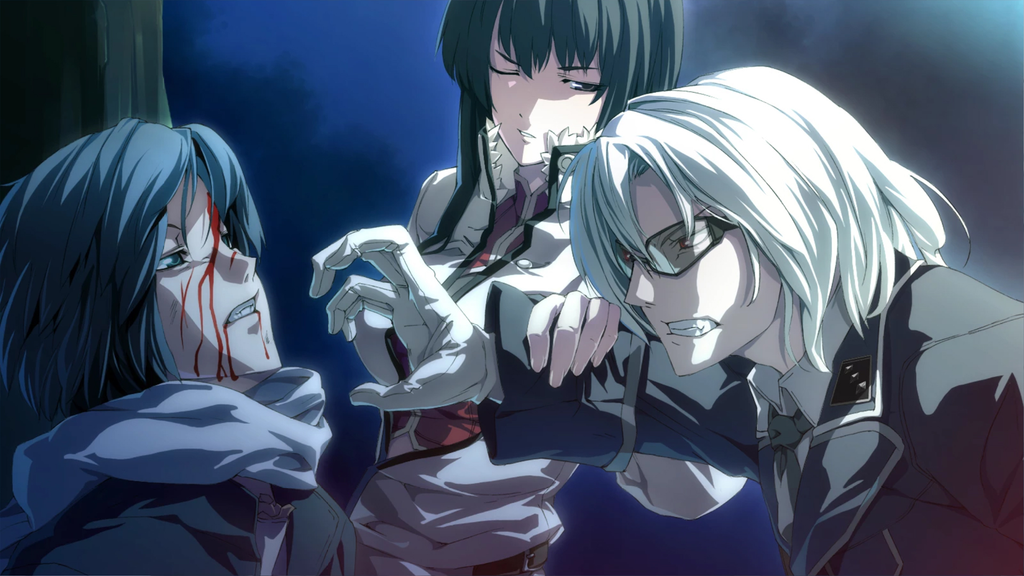
There is no other story that values and embodies cliché the way Dies Irae does. Not even the most mundane of narratives. Here is a story that seeks to liberate itself from the confines of traditional storytelling not by deconstructing them, but by coveting and pushing them to their extremes while inviting the audience to see what comes out of the other side. This is a story not so much concerned by what it’s doing, but how it is doing it. It stars your typical high school student (Ren Fujii) who just wants to protect his daily life suddenly thrust into a battle against a group of Nazis (calling themselves the Longinus Dreizehn Orden or LDO for short) who disappeared during the end of world war two, but have started showing up again. Dies Irae takes all the elements that would otherwise make a player’s eyes roll and decides to revel in them. The absurdity of setting one man against a group of wizards isn’t lost on the story as it makes a point of being extremely self-aware. What you get in Dies Irae (and what makes it so ironically unique) is a story that takes the known, tired, recycled ideas of tales galore, cranks up the music, and elevates them to grandeur.
The setting is the fictional city of Sawahara where Ren and his friends need to stop the LDO from opening up eight swastikas around the city using human souls to bring back their leader, Reinhard Heydrich. Our heroes consist of Ren, our protagonist, his childhood friends Kasumi and Shirou, Shirou’s new friend Ellie, their upperclassman Rea, and the girl who appears in Ren’s dreams, Marie. Yes, we have only six main characters with minimal interaction with the supernatural tasked with defeating the thirteen members of the LDO who have had decades of training, and although it may seem heavy-handed at first glace, I don’t think that the term hard-to-believe should be applied to a narrative like this where cliché is the name of the game and Déjà vu is around every corner. While I won’t go into detail with all the members of the LDO, their most striking members include Wilhelm, a strangely loyal sadistic vampire, Schreiber, a serial killer wearing the mask of insanity to protect a broken mind, Rusalka, an impish witch with eyes that seem to swallow the player if he stares at them long enough, among many others, including the eternally hated vice commander Mercurius, and the aforementioned Reinhard who has a deep and charismatic voice to go along with his long and perfect hair. As with any dramatic and over-the-top story, the more titles a character holds, the stronger they are, and here that honor belongs to Reinhard aka Mephistopheles, First Seat of the LDO, The Beguiling Light, The Golden Beast, Monarch of Destruction, Lord of the Seven Kingdoms, King of the Andals, the Rhoynar, etc…
Of course you’ve heard of a similar plot before, we’ve all heard this story before, but not one that so stubbornly commits itself to its own rules. There are eight swastikas around the city, 6 main heroes and 13 LDO members, and by the end of the game’s 80ish hour runtime, these rules are still exactly the same. No new characters, new villains, or new rules just different roads. Even the word twist doesn’t seem to exist in the author’s vernacular. Everyone and everything mentioned in the game’s opening act remains relevant by the end of it. Ren is set against the LDO with Marie at his side with the author foreshadowing their every victory right from the beginning. Mercurius, who always appears to know more than he is letting on, narrates what is in my opinion the most infamous opening soliloquy of any visual novel in existence (elevated by Toriumi Kousuke’s immaculate performance), where he invites everyone to the upcoming battle claiming it his opera describing it as The Height of Cliché. Why would we want to experience something like this? His reasoning is: you have never seen it done this way before. Scream louder! Hit harder! Chant more Latin, and you’re on your way! What Masada Takeshi (the writer) wants to achieve with Dies Irae is to bring about a “Day of Wrath” that is subjugated under the ultimate “Rule of Cool”. A notion that is only matched in its absurdity by its theatricality. The feeling you get from playing Dies Irae is like rewatching a show you have never seen.
Light has definitely done something amazing here. They gathered and gave birth to one of the greatest performances of any groups of voice actors to ever grace the medium. Every voice actor plays out their role to perfection with nary a complaint passing through. I truly believe that every performance in this game deserves to be called a career high performance by each of the VAs. Every spell cast is preceded by a chant, and the more powerful the ability the longer the chant. These spells are based on a character’s hopes and beliefs which are used to personify their desires onto the world powering up themselves or the space around them. Now, Dies Irae will take its time explaining in long, indulgent narrations the nature of its world, philosophical concepts, and characters’ powers. These are all told from the perspective of characters who love the sound of their own voices. All the while, the player will be accompanied (and at times led by the nose) by a meticulously designed soundtrack. One that wants you to be at the edge of your seat for every bout, and if possible standing up and cheering for the characters as they fight for their lives. There is one instance I feel I need to call the game out on though because of how out of place and frankly vulgar the choice of music was. There are murders happening around the city at the start and when we learn who the killer is and Ren stops them, they reach some sort of resolution, but what proceeded to follow was the track that we usually hear when everything is resolved or characters have made up. I think it was distasteful to have this track play here, not with a victim’s severed head still in the killer’s hands. The game already has a problem remembering that other people live in this world besides the main characters, let’s not pretend that they also don’t matter. All these happen outside of the fight scenes mostly so as not to disrupt the rising flow of excitement; as for the fights themselves, they largely go uninterrupted (something I implore other writers to learn from). It’s not hard to imagine Masada sitting back watching the voice actors work, and having them repeat the same lines over and over again louder and louder until they genuinely believed in the power of their own words. Other stories will laud themselves for having their characters scream their lunges off not having the subtlety to play the characters any other way. For me, nothing compares to the joy of hearing how each and every character unlocks their craving by saying the word ‘Beriah’! Wilhelm saying it causes your skin to start crawling. When Schreiber, with his German-speaking guns-blazing attitude says it, the goosebumps just can’t seem to stop. When Rusalka spreads her hands, lets her hair flow, focuses her eyes, and yells it, it doesn’t seem to come out of her mouth but from her soul! I don’t think anyone can overstate just how marvelous the voice acting in this game is.
For however much Dies Irae is lauded as a legendary game within the industry, there are equals amounts of criticism directed at its overindulgent and clichéd nature. This is where your mileage will vary. I agree for the most part that guaranteeing the main character to win right from the start removes any tension that could’ve followed especially one where people are supposedly engaging in fights to the death. I do feel the need to point out though, the fact that Dies Irae can spend hours indulging itself in random philosophical nonsense between two people who see themselves as larger than life is exactly the point. While anime might be able to move these characters like no other and books might cover the long incessant philosophical meandering, nowhere else will you find a medium that lets its characters ramble on for hours with Latin choruses playing in the background having this kind of evocative hand-drawn anime-style portraits. Nowhere else can the audience choose the version of the Play they want to watch, with Dies Irae allowing up to four versions of its story. Most importantly, nowhere else can this type of meticulous slow-burning writing style be as effective. Still, it would’ve been nice to be able to sweat alongside the characters… This leads to two of the biggest contentions of the game: the protagonist and the pacing.
Something that will strike anyone when playing this game is how much the villains overshadow the main characters. Wilhelm alone is enough to overshadow most of the main cast, so when you add Babylon, Trifa, Eleonore, and Reinhard and his beautiful eyes, it makes you wonder why you aren’t just following their story instead. Ren is dragged into the story and if he could guarantee his friends safety, there is a big chance he might opt out. His goal is to keep the life he has now, so at the end of the story he would only gain what he already had. Shirou and Ellie are in this for the thrills so they aren’t really after anything (though they do make the story endlessly more entertaining), Kasumi is irrelevant, Marie doesn’t have a goal in the beginning, and Rea spends the first two routes looking for a role to play as her turn hasn’t come yet. The villains, however, all joined the LDO because they have a wish or a craving they want fulfilled. Kei wants to bring the people she loves back, Wilhelm wants his curse removed, Schreiber wants to be the fastest, and Rusalka has a craving so shockingly humane and relatable, one wouldn’t expect it from a sadistic witch. There is urgency in their lives, but sadly the writer didn’t extend this to the protagonists. It isn’t impossible to write a character that only focuses on surviving, but this becomes an issue when the character is boring even by conventional standards. Ren isn’t exactly a Mary Sue. He is willing to kill to protect his normal life, and his friends’ lives mean more to him than other peoples’, but he doesn’t bring anything new to his role of “Main Character”. His obsession with his daily life is something he is constantly mocked about by Mercurius, Wilhelm and many others. He is supposed to win because of his role, but I never cared for him the way I cared for any of the other characters. I never felt desperate for him to survive, and knowing that he will, didn’t do his arc any favors. It certainly didn’t help that one of the characters connected to him is literally called ‘Deus ex Machina’. Man’s looking at plot armor in the rear-view mirror. Ren himself seemed more like a tool the author was using to make his villains standout rather than have his own narrative. He is handed everything on a silver platter (as is the rule with most main characters), his weapon can instantly kill others, he has an infinite regeneration ability, two of the four main women already love him by the time the story starts, and the other two fall in line not soon after their routes start. I started losing interest in Ren as soon as Shirou reenters the story with Ellie around the Fifth Chapter because I saw that the author can write entertaining protagonists if he so chooses, and right after that Reinhard’s three Knights are summoned bringing with them carnage, devastation, and lastly the apocalypse. Ren, especially, is not just overshadowed, but eclipsed. He isn’t the worst character in the game though. No, that honor belongs to Kasumi.
The story is separated into four routes to be played in the following order: Kasumi –> Kei –> Marie –> Rea. These are not only ordered by writing quality, but also by their sense of scale and story advancements. If you bought the steam version of the game, then these four routes are available to play from the get go in any order. I don’t know whose decision this was, but this only hinders the people who go into it blindly. When I was researching what people have thought about this game, I found that the website erogegamescape (the Japanese equivalent of vndb) has a statistic that shows around which point a game gets interesting. It was thirty hours for this game, which is around the point you’ll have finished the common and Kasumi routes. This is a feature that I fully disagree with as any good story should be interesting right from the beginning. I don’t believe in the ‘it gets better later’ idea. Give me a reason to start not a promise to stay, which is funny because Dies Irae might be the only exception I can think of that needs people to tell them that Kasumi’s route, which should be their first, is not any indication of the promise this game holds. I wish, oh how I wish, that I can tell people to just skip this route and start Kei’s right away, but it sets the stage and prepares people for what the other routes deal with. Most of the villains don’t even appear in it and nothing gets resolved, with only a promise that they will wreak havoc next time. It provides the world-building and power system that will be used along with an amazing fight between Ren and Cain, and Wilhelm and Shirou near the end of it. Kasumi however, turns the story into insufferable torture as if Masada wrote this with someone pointing a gun to his head.
Kasumi is one of the main heroines for reasons I will never understand. She is Ren’s childhood friend and is meant to represent the normal life he longs to return to. THAT’S IT! This is something we pick up from the first few conversations they have and is the role of the traditional childhood friend, after that her importance diminishes faster than the speed that Schreiber hopes to reach. In many ways, Kasumi is worse than the Nazis. Kasumi is LOUD! That is her core defining character trait. Most of her dialogue is spoken through a microphone begging someone to put it out of its misery. We don’t have that privilege. We have to sit through her constant badgering of Ren whenever she enters a scene. She wants to know where he was, where he’s going, what he’s doing and who is he doing it with time and time again. She wants to be his sister, his mother, his lover, his older sister, and the only person important in his life. She shares an apartment next door to him and breaks the wall between them so she can enter and leave his apartment whenever she wishes. What annoyed me most of all is that she is never called out for this giant sense of entitlement she thinks she has. I don’t know why the author decided to shove her into what should’ve been one of the most important entrances in the story. After seeing Marie in his dreams multiple times, Ren finally wakes up to find that she is now is his room. I couldn’t wait to see him and Marie meet, touch, and talk for the first time only for her to intrude on the scene and scream her head off asking Ren who this girl is. She then proceeds to spend the rest of the day with them as if that wasn’t bad enough. What’s worse is that she thinks she’s funny! When Ren tells her that he is going out with Kei to get her away from him and she is taken by Ellie to the club to see where Ren and Shirou were hiding out, her first question isn’t “where have you guys been”, “what’s going on”, or “where are we”. No, the first question that she absolutely must have an answer to is “Ren do you really love Kei? Tell her you love her here right in front of everyone” while smirking thinking he won’t do it. When Kei suggests they kiss to prove it to her, she (for once in her life) shuts up and sits down. There is an earlier decision that the player can make to “Drag Kei away” or “Drag Kasumi away”. If you choose the former, Kei will remark after they get away from her that she thought she saw her crying. So was I. Tears of joy. She is ever-present in the common route and no choice available to us ever results in her going away or disappearing. This is only in the common route though, after that Kasumi rarely ever appears again, which only reinforces the idea of why should she even be there in the first place. I wouldn’t fault anyone who dropped the game because of this screaming banshee of a tumor. There isn’t any indication that she will be removed from the story either, but it was the biggest relief I had in the game after her route ended. I couldn’t believe how much the writing improved in Kei’s route when she wasn’t the main focus anymore. She quickly changes from ‘main character’ to ‘supporting’ to ‘makes an appearance’ in a matter of minutes. Who knew removing annoying characters had such a positive impact on the narrative? At one point Ren senses that Marie’s moral principles aren’t well-adjusted, and so he asks her if she would kill Kasumi if he asked her to. She thinks about it, and smiles impishly while saying she would if he asks her to. I’d like to believe she was speaking for all of us when she said that.
Another issue that the game suffers from is the very weak romance written into it. Rea and Kasumi already like Ren before the story starts and don’t get much scenes with him that build on their relationships with him. Marie and Ren had some sweet moments, but they needed a lot more before they convinced us that they loved each other. It happened too abruptly in most cases. Kei is the only romance that develops naturally and that is because they didn’t know each other before the story started, so the audience are watching their relationship start and develop in front of them. I think the author makes it obvious that Ren likes Rea right from the beginning and it’s not that hard to believe it when the confession comes as he has shown signs of liking her in all the previous routes, but a few more scenes like how they met, when they realized, and what happened when they got home that day would’ve gone a long way. If I am asking for too much then that is only because I felt that some heroines were treated too blithely by the author. I think it would’ve been better to tie the routes’ names to their themes rather than women similar to how Full Metal Daemon Muramasa did it. Kasumi’s route would be the one where the actors aren’t prepared enough and they’re still holding the script in their hands, ultimately a rehearsal. Kei’s route would be one were the actors veer so far away from the script that the director pulls the plug on it not caring how entertaining it was. Marie’s route is where the actors follow the director’s orders to a T, resulting in the director finally getting what he wants. Rea’s route then, played last, is the one where the actors bring something to their roles that the director never knew they had. It fits that in that route, Mercurius has a moment of negligence due to how passionate some of the roles being played were.
Dies Irae is sitting at only 630 reviews on steam, which prompted me writing this review. I want more people to experience this game. It has a lot of philosophical jargon that might put some people off, but they aren’t a prerequisite to enjoy it. Sure, you can get more out of Dies Irae or even enjoy it on another level if you are familiar with Faust, Nietzsche, and Buddhism, but they aren’t the deal breakers people are making them out to be. They help tie the story more into its themes of nationality, morality, the futility of man playing God, but the story always makes sure to explain and allude to these concepts more than people seem to give it credit for, and sometimes they give it too much credit. Sometimes a man screams “Halt, time! For thou art fair” because its a literally reference and speaks volumes, and other times he does it because the author thought it sounded cool.
If we are to believe that this is indeed Mercurius’s Opera, then he is to be its playwright. A playwright that deserves applause just for the sheer scale and audacity it took to write a story like this. He shows that there is still originality to be found in even the most unoriginal ideas. It is the way they are treated that makes them flourish. When that final fight starts in Rea’s route with the universe at stake, the entire cosmos is there eagerly watching it happen. It is not an exaggeration to say that Mercurius was waiting for that moment his entire lives. I have not been so thrilled to see a fight unfold nor exhilarated to see its unfolding since I heard the words “…and this… is to go further beyond!” Now, Mercurius’s Acta Est Fabula belongs in the same breath as that iconic line.
Dies Irae is a classic visual novel for a reason. After I finished the story the first time, I didn’t think much of it and was mostly disappointed by many scenes I felt should’ve been added, but then I couldn’t stop thinking about it. Its tightly constructed world, its stunning character designs that never leave you, and of course its unforgettable cast. On my second playthrough I played the steam version with the extra side stories that fixed some much needed narrative gaps. I also learned that you can mute any character you want from the options menu (a feature I will forever be grateful for). I started and finished my third playthrough of the game not too long ago because I missed it too much to bare. I will keep criticizing this visual novel for wasting my time with Kasumi, I will keep criticizing it for making such a lacking main character, and I will keep criticizing the horrible romance in it, and yet I will keep coming back to it for I have never seen a story I already knew told in so grand a way! Such is my reason for loving and recommending this epic tale. As was promised, the actors were indeed exquisite.