Warning: Game has 18+ scenes
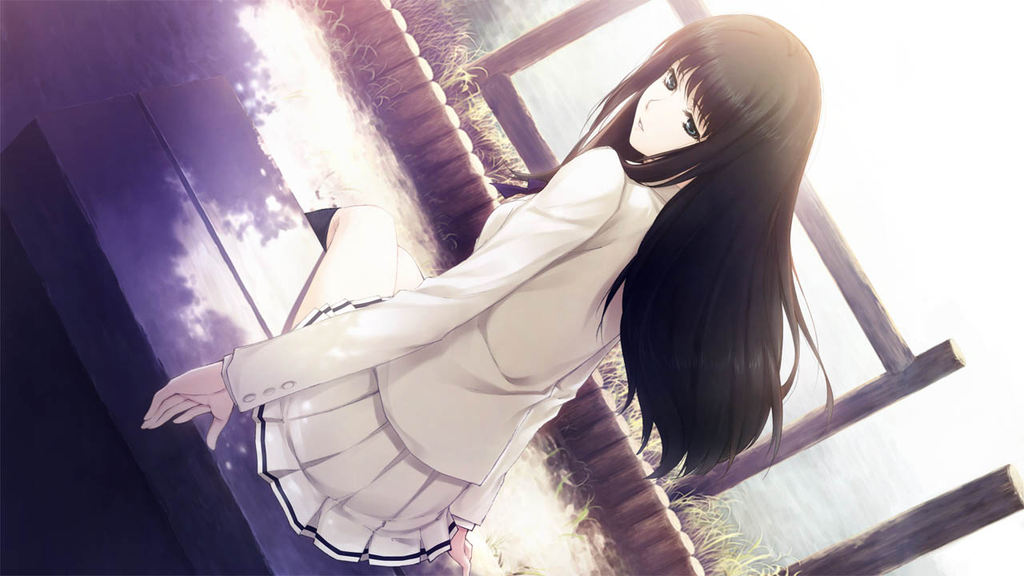
Well, this was a long time coming. It was only a matter of time before the homogenous, self-indulgent, moe-infested releases that have been plaguing the anime and visual novel industries led to the birth of a product that consciously acts as the antithesis of all that its predecessors held sacred. This silent explosion of gore and sex that is “Kara no Shoujo” could only come about from minds that were well-aware of the criticisms of these industries, and have made it their goal to show their contemporaries the potential they have been sleeping on. Almost painfully so…
Kara no Shoujo takes place in the 1950s in post-war Japan, and focuses on Tokisaka Reiji, a policeman turned detective living with his sister modestly watching the days go by. He doesn’t really stand out and his current job feels like something he fell into rather than strived towards. His fondness for history and reading is much more apparent. He and his friend Uozumi always carry with them that military air, that irremovable stench of trauma that in many cases hardens a person’s resolve or in others, like Reiji’s, forces them to take a step back. The story starts with a string of exceptionally gruesome murders involving a group of girls from different schools. Reiji is tasked with looking into them and ends up working as a temporary teacher at his sister’s school. Before he starts there however, he is approached by a friend of Yukari’s, Kuchiki Touki, and she hires him to find her “true self”. Soon after, events start unfolding and Reiji discovers that the case is eerily similar to the unresolved one from six years ago that claimed his fiancée.
The game spares no time introducing its characters. I had just started learning about the students before the teachers came by and said hi. Then I took a trip down to our character’s Detective agency and got introduced to some other policemen and friends along the way. After that the game sent me down to the Kuchiki Clinic where the story’s most important characters came into play. There was also a museum, a church, a café, the police station etc… all of which have new characters with their own reveals later on, and the game is very subtle in bringing these characters to the spotlight. It is also very keen on presenting its setting as fact and not just a backdrop to the story. It would be remiss to call the backgrounds here as just that because rarely do characters in visual novels interact or fit into them like they do here. The café owner Kyouko moves between our viewpoint and the counter, and Touko moves between her bed and our point of view. We don’t separate the backgrounds from the ever-present sprites as both seem to complete each other. We always get the feeling that the characters were living in this world way before we started playing the game. They interact with it, they move around, and by interacting with them we can almost share the experience. I wanted to visit, see, and touch every location in this game because of its powerful and vivid presentation of the era it takes place on. A feat shared by the company’s earlier work Cartagra, though here it is showcasing a much more urban and intimate approach. One that fits perfectly to the story it’s telling.
I loved the way the game looks almost as much as I loved the way they designed the characters. Sugina Miki spares no expense with their attention to detail and meticulous outlining. Uozumi’s gruff design and rough appearance fully embody the type of character he is before we even hear his voice. Touko’s ethereal sprites scare the players into thinking that every time they meet her might be the last. Touko’s friend, Mizuhara Touko’s face is always caught between panic and fear. Stella, a museum employee, wears a stunning Victorian inspired long-sleeved blue dress that is complemented by her white gloves, golden hair, and soft demeanor. She stands as a testament to the effect that anime-styled designs can have on the audience, and reminds us why we go to visual novels instead of anime. Sometimes seeing a fully detailed picture talk is more evocative than seeing a rushed cheaply drawn one move. Sugina Miki and Suzuka Miya complement each other in a similar way to how Takuechi and Nasu do, but one of the major differences between them is that although the formers lean more into realism, they don’t assume the role of the players like the latters do. They don’t know how aggravating it is to play their games.
Kara no Shoujo’s story, written by Suzuka Miya, is a deep web of mysteries all spiraling down in a vortex of blood, madness, and paranoia as we slowly watch everyone involved with the murders ending up dead, dismembered, and/or traumatized. The players aren’t just viewers; they have to make an effort to solve the mystery. Choosing what to do each day, where to go, and which evidence to use changes the outcomes severely. Reiji might choose to spend time at home, or go for a walk in the park late at night and the world is then forever changed. He might link an unrelated evidence to an important one; even going so far as to kill a few people if the players really mess up. But what I was mostly surprised by, as I am sure most people were, was the correlation chart. This is the game’s greatest surprise. It shows the players how the people in the story are connected, showing pictures and arrows pointing to one another. You start off with a few connections, but what is truly stunning is that by the end of the game everyone is somehow connected to everyone else! Answers come from the unlikeliest of sources, some of the biggest payoffs in the game come from being nice to people. Reiji is a bit of a sketchy character, so people are usually on their guard around him. These same people are the ones that’ll leave Reiji with what he needs to finally make it out of the horrendously designed maze that is the game’s structure.
Sugina Miki, also acting as the game’s director, employs a master’s touch. The director’s first game, Cartagra, also shared many similarities with Kara no Shoujo, but he comes off here as a seasoned veteran in visual novel design. Kara no Shoujo can almost be mistaken for a sound novel with the strong emphasis it has on its soundtrack. All of the game’s pivotal moments are accompanied by pieces of music that couldn’t be more apt. Finding the abandoned house in the middle of the forest while “karanoshoujo” plays in the background is an unforgettable moment of pure paranoia. Seeing what become of Reiji’s fiancée as “Despair” demands the player’s attention is one of the game’s most visceral moments. We see that the director has taken the extra care to present their game as an authentic artistic piece of Showa era literature rather than the experimental attempt made by Cartagra. He has brought together the most unique aspects of visual novels from the artwork, to the music to the detailed cgs and refined them to the point where there can be no doubt over their authenticity. Which is why it is disappointing to see the lack of forethought put into the game’s structure and story. Sugina Miki has everything a great director needs except commitment.
No player should every feel the need to play a game with a guide on hand. When playing other adventure games like Phoenix Wright, Zero Escape, or Famicom Detective Club, there is a known sentiment that “if you don’t know what to do, just click on the screen until something happens”, but that strategy won’t work here. The director obviously wanted people to focus on the mystery and reap the fruits of their labor, but if that was their intent then they should’ve focused more on the logic behind those decisions. There are too many permutations in the structure. Kara no Shoujo uses a much more infuriating way to explore its world. The players will eventually have a long list of evidence any of which can be used at any moment when talking to people. In addition, there are at least two decisions that the players need to make every day leading to many sadistically designed bad endings where most people will get stuck at for days without the use of a walkthrough. The worst part is that getting past the constant deaths and bad endings requires a great deal of luck. The story doesn’t advance by choosing the logical choice but the arbitrary one. You have to reach the truth the developers wanted you to reach not the one that relies on your acquired information. The most notorious example is a picture I found near the end of the game and based on that the killer changed their location and killed a main character (a person they don’t kill if you don’t find it). The problem here is that the killer has no way of knowing that I found this picture and they would still have no reason to go to that place even if I did. The game locked me out of everything that didn’t lead to a bad ending because I decided to visit a museum instead of a hospital ONCE in my twenty-five hour playthrough. The players can’t rely on logic to find the killer (at least not completely), they need to be ready to leave lots of save states and experiment with Reiji’s train of thought and numerous hard-earned evidences before they can expect a breakthrough in the case. This is where they will also spend most of their time sadly, and given the number of decisions and the long weeks spent in-game seeing bodies pile up and not getting any closer to seeing the case being solved, it is easy to see why many players give up on solving it and rely on a guide. Using it however, turns the game into a monotonous activity, and any involvement from the player’s side decreases with every given answer. I tried solving the mystery many times before resorting to a guide, but the version I played was the 2008 released one translated by Mangagamer. Back then we had a limited number of clicks around a crime scene before we weren’t allowed to anymore. Add that to the number of issues we had to go through, the true ending was always out of my reach. This issue is rectified in the remastered version licensed by Shiravune since now the players have an unlimited number of clicks. There is no need to worry about time running out anymore, but I would still be shocked if players naturally found that picture without someone telling them that it was there. We really could’ve benefitted from a hint system as utilized by Type-Moon in their visual novels, or the way the main character reaches a bad ending and then thinks about the specific decision that led him towards it like in Biniku no Kaori. But because the game’s weak and arbitrary nature is always apparent, a hint system could only have taken players so far.
As much as they tried, they couldn’t completely separate Kara no Shoujo from its eroge origins, and neither could they Reiji from his archetype (another issue that questions the logic in this game). Reiji is being held at knifepoint before a character asks if he wants to engage in their genre’s trappings. Another girl goes insane before she unlocks her own sex scene with him. It is not just that these scenes are uncomfortable, but that they don’t make sense given the context outside of making sure the protagonist achieves his eroge goal of banging them all. The developers couldn’t reach a balance between wanting to craft a realistic experience but also reassuring the players that every girl will eventually crave the main character. Not to mention that the story never takes Reiji’s feelings into consideration (the same lack of attention given to every harem protagonist). His role is to just say yes when the women bend over. This was an extreme detriment to the experience, and the players can’t ignore these inconsistencies because they spent hours dying to wrong decision making just to reach these insufferable endings. To paraphrase what Roger Ebert once said of Alfred Hitchcock heroines: “Sooner or later every Innocent Grey woman is humiliated”. Whether it’s in the bad endings or the sequels.
When it comes to the presentation, it should be pointed out how the murders in this game are especially gruesome. The world of Kara no Shoujo is a cold, cold one. Suguna Mika really wants to drive home a theme that is often misrepresented in mystery stories. Detectives don’t prevent crimes, only solve them. This is something that Reiji and Touko discuss over his fiancée’s grave lamenting the fact that he is a detective and due to the nature of that job he will only be called upon after a crime occurs. Meaning he will always arrive too late. In a medium littered with self-indulgent power and love fantasies, making the players feel for these characters before literally cutting them out of their lives is the main draw of this game. It makes a point of showing the murders in full display for the player. The screen changes to red, the game’s title is shown, and then we feel dread because we know that someone is about to become a victim. Suddenly we are playing from the killer’s perspective. Feeling every slash and amputation as they do it. Even going so far as to describe the feeling of shoving a plastic egg into a dead woman’s uterus. Characters will be built up for hours before they end up being the next victim with no way to save them or anyone mourning them. This is the part that took me out the most. I was the one feeling for the victims more than the characters. The victims’ families are never shown to the player nor does Reiji care much about most of those who die. These girls are being amputated, and parts of them are being thrown all over the city so you would expect the police to be more concerned than they are shown. Neither do the reporters seem all that interested for that matter. Most of the characters are lacking in empathy, and it’s as if someone dies and, having achieved their goal (being no more than shock material), they cease to have existed in that world. I saw killers committing the most heinous of crimes without the story feeling the need to give them a proper motivation. I watched as accomplices commit similar vile acts without much of a thought behind them. A body is discovered, uteri are removed, and the world moves on. The game does act like a standard bishoujo game in this aspect. In those games, pursuing one girl often causes the others to suddenly disappear from the story. Over here the author, almost mockingly, adheres to this practice, but gives a reason why they can’t appear anymore. You can almost hear them telling the victims “this is what happens when you aren’t the main heroine”. Not that being the main heroine in an Innocent Grey game ever kept anyone safe.
Going back to the structure of the game, it is working against the narrative and the authors don’t seem to realize it. I stumbled upon many bad endings, and later learned that the true ending can’t be reached from the first playthrough anyway. After seeing many characters being mutilated, there is a huge sense of relief when they are subsequently alive in the true route if you make the “correct” decisions. Some of the deaths are set in stone, but others can be saved. It is natural to assume that players will try to save the characters they loved (or everyone if they could), but there shines the developers biggest failure. When I learned that I can save some of the characters, I didn’t feel anything but the most fleeting of sadness when I started seeing more killed. I just thought that I would see this bad ending through to the end, and then try to save them in the next one. There is also that aloof sentiment that bad endings are never taken seriously either due to being non-canon, or just timed game overs. I naturally assumed it was a bad ending because that is all that has existed so far, and I didn’t realize the depths of the author’s sadism (there is no way they would kill main characters this often and then forget about them, right?). The sense of apathy that starts growing in the player is not what they should be feeling, but when I finally reached that true route and found out that these characters will stay dead, all I felt was an air of indifference. The game had numbed me. I couldn’t find it in myself to care about these characters now when I should’ve cared for them when they died the first time. Murder (and in this case mutilation) should be given its due weight, but the game doesn’t treat these themes with the focus that they deserve. They missed that vital bite that, regardless of the character, death should always have. No story should ever pride itself on desensitizing the audience to murder.
Thankfully, we are spared the complete clutches of this apathetic story in the form of Reiji’s sister Yukari. She is the audience’s only emotional surrogate, and a stunning example of the exemplary character writing in the game. Yukari is soft-spoken but blunt, airheaded but sensitive, quirky but not dumb in other words the perfect sister. She is always there for her big brother, and helps keep his life in order. She is also there for the audience when they need a reminder that not everything in this game is dark, grim, and tragic. If the character deaths in this game affect anyone, it is Yukari. We look to her for emotional fulfillment because like us she has to stand by and watch her friends killed one by one, and seems to be the only one who cries for them. We also see the world from other characters as well. We see Touko’s loneliness is in full view and a central part of her character. We can see why she, unlike many of the other girls, has a deep reason why she falls in love with Reiji, and why she is the poster girl. Shuugo, the main character of Cartagra, also gets a spotlight. Mizuhara Touko also gets more screen time and a sly move from the author’s part as she gets more involved in the narrative. There is a moment in her house where after finding a book she shifts from being an annoying character to one the audience needs to keep an eye on. The characters are very realistic in nature more so than is expected in this sort of narrative, but the story isn’t up to their standard. In the end they had to settle for being shock material instead of key parts of the narrative because of a mistake in priorities.
This mistake also hinders the game’s final act where we arrive at the killer and the game decides to forgo explaining their motivations in detail. They gave them a sad backstory, a Freudian excuse, and expect the players to accept it. Their goal is to kill first explain never later. To top it all off, the developers have the gall to end the game on a cliffhanger. It is not as irritating in hindsight since this is just the first part of a trilogy now, but back then Kara no Shoujo was the full title. It didn’t have Part I at the end and was considered a full story. Though anyone who plays it can see that a sequel had to have been somewhat considered back then because to reward the players after they had to spend weeks maybe months figuring out how to reach an ending that calls into question the right state of mind the developers were in to end the story with an abrupt and unfulfilling ending seems too abhorrent and sadistic. I certainly didn’t enjoy being flung around from one arbitrary decision to another and then having to scour the internet trying to find the right answer only for the game to tell me to go play the sequel. There are multiple storylines in Kara no Shoujo, the murders, Reiji’s past, Touko’s circumstances, but they all reach similarly unsatisfying conclusions. When Reiji is holding a sadistic killer at gunpoint at one point in the story, it is excruciatingly unconvincing when he chooses not to shoot. The writer needed a sequel hook after all.
Kara no Shoujo is the premiere example of how important the writer is to a visual novel even when all the other aspects are guaranteed. The visual component needs to be complemented with strong writing, and you can have an amazing soundtrack, breathtaking visuals, and shocking reveals, but they can only get you so far before people start recommending your music and art over your product. In many cases, the player’s patience might run out before your explanation does. The story doesn’t take full advantage of its medium and the segregation across multiple routes has more of a hurtful lasting effect on the players than any kind of positive one. There is a lot that the game does right, but it’s all marred by how frustrating it is to play and how unsatisfying the conclusions are even with a lot of great plot twists to keep the players going. Those twists really are high points even compared to other mystery visual novels, but I always make sure to tell people to buy the sequel along with this game as it isn’t worth it on its own. Even if I don’t, the game’s true ending itself may be enough to vex most into angrily buying the sequel.